The gate outside the window
The Puerta de Alcalá, explained
The story of Madrid's Puerta de Alcalá and the Plaza de la Independencia around it: who built the gate, what it is made of and why it matters to the city.
Reserve your flamenco night ↗Quick answer
The Puerta de Alcalá is a neoclassical gate that King Charles III commissioned from the architect Francesco Sabatini around 1774 and that was inaugurated in 1778. It stands in the Plaza de la Independencia, near the main entrance to Retiro Park, and Flamenco de Leones sits on the same square. The gate is one of the symbols of Madrid and part of a UNESCO World Heritage Site.
A gate on the road to Alcalá
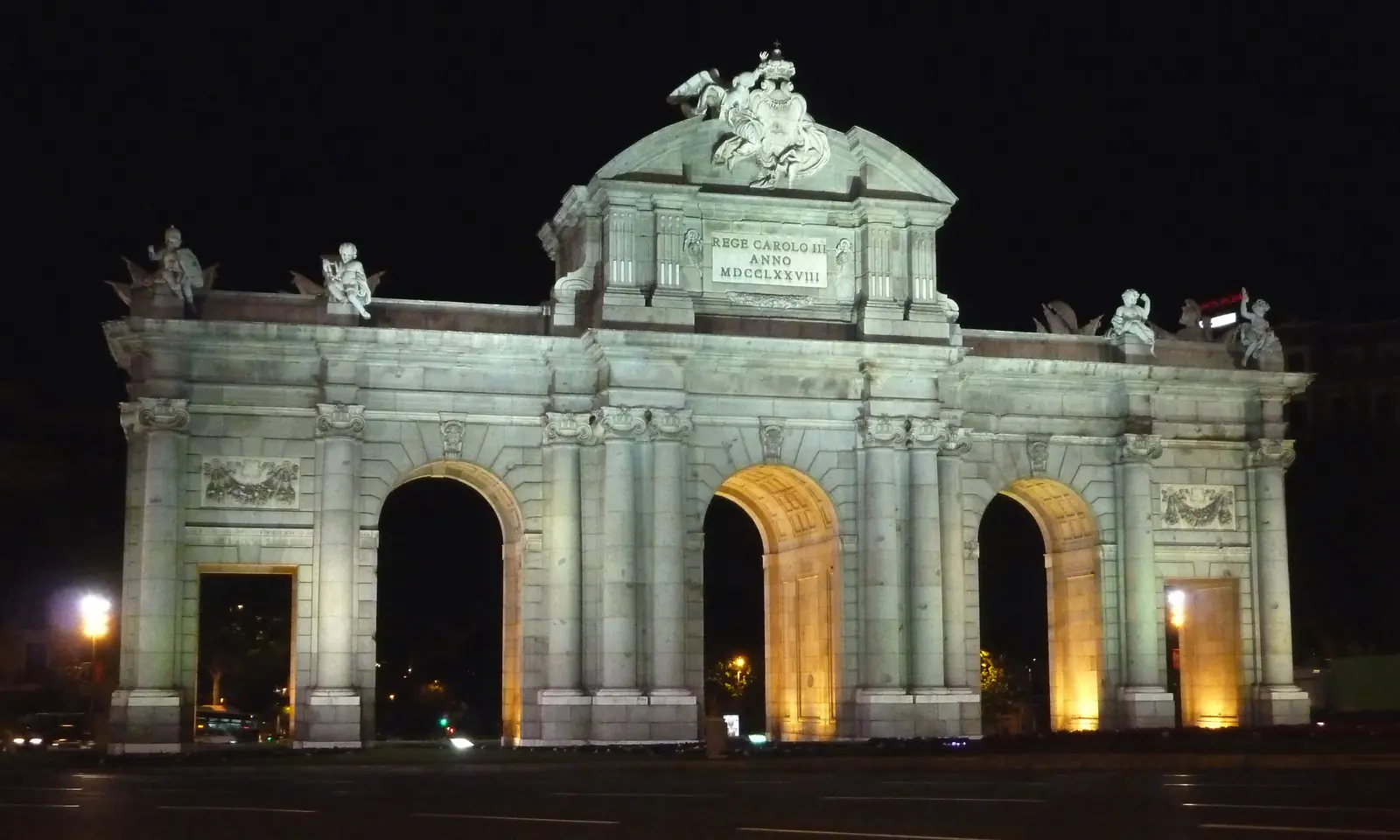
The Puerta de Alcalá was a gate in the former walls of Philip IV, and its name comes from the old road from Madrid to the town of Alcalá de Henares. Around 1774, King Charles III commissioned Francesco Sabatini to build a monumental gate through which an expanded road would pass, replacing an older, smaller gate that stood nearby. It was inaugurated in 1778, which is the year spelled out on its central plaque.
A city that ended here
Wikipedia describes Madrid in the late 18th century as still looking like a somewhat drab borough, surrounded by medieval walls. Charles III wanted a monumental entrance to the city on its eastern side, and the Puerta de Alcalá was it. The gate stands where the city once stopped. Today the plaza is a junction rather than a border, but standing in front of the stone it is easy to picture the edge of town.
Stone and sculpture
Wikipedia describes the ornamental details as sculpted by Francisco Gutiérrez and Roberto Michel, and made of white stone from Colmenar, while the main architectural elements are Segovia granite. The central plaque reads rege carolo iii anno mdcclxxviii, the king's name and the year in Roman numerals. Cannon shrapnel once struck the gate, and the marks can still be seen. Next time you pass, look for the pitting on the stone.
The plaza around it
The Plaza de la Independencia is a central roundabout. Calle de Alcalá runs through it east to west, though the street does not pass through the monument, and the square is the origin of Calle de Alfonso XII, Calle de Serrano and Calle de Salustiano Olózaga. The Paseo de México runs from it into Retiro Park. The gate and plaza were built in 1778, but the current shape of the square dates back to 1869, and it is mostly surrounded by buildings from the late 19th and early 20th centuries.
A symbol of Madrid
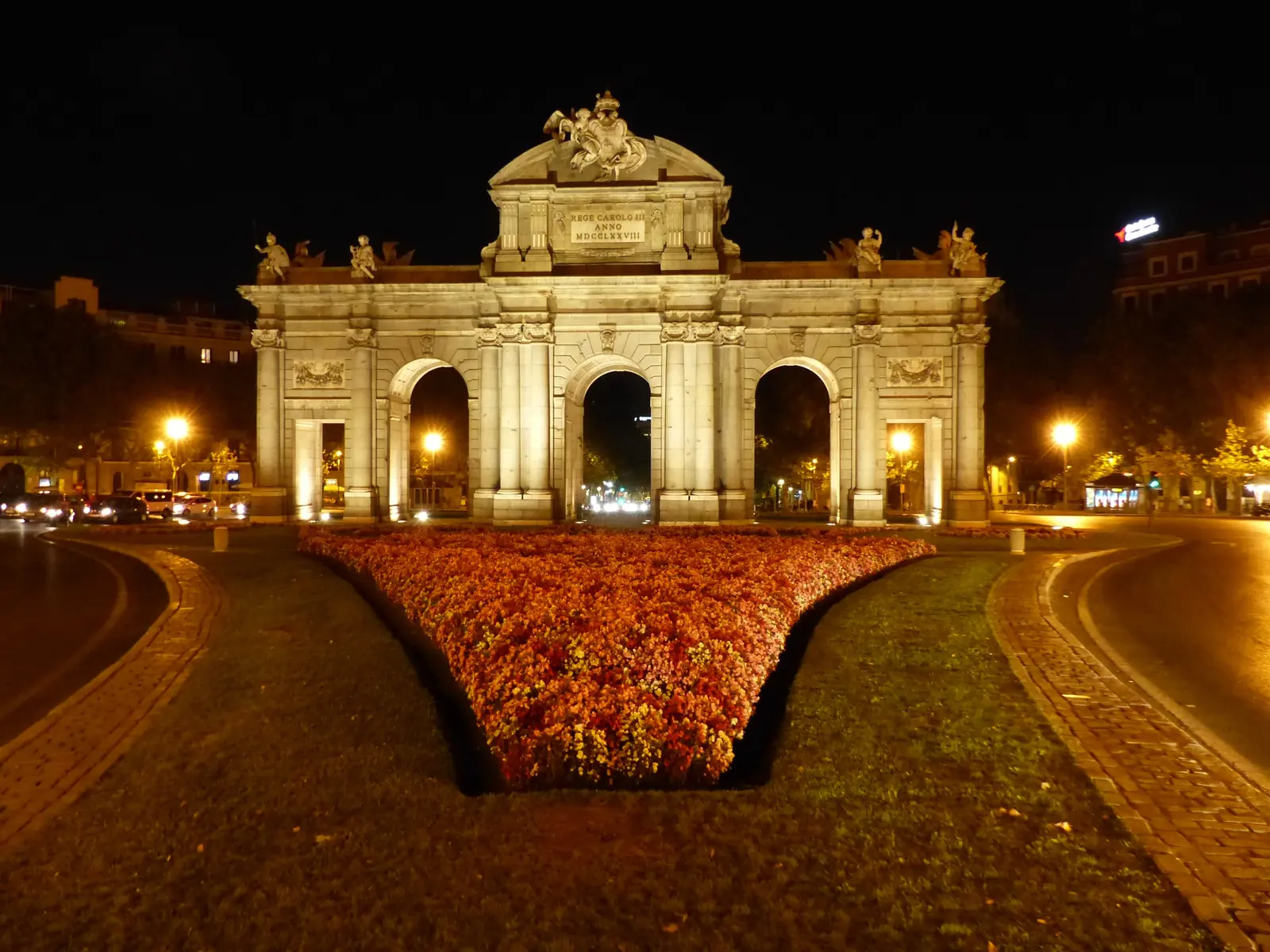
Wikipedia calls the gate one of the major symbols of the city and says it has been described as a second kilometre zero within Madrid. It is part of the Paseo del Prado and Buen Retiro UNESCO World Heritage Site. In 1985 the Spanish singers Ana Belén and Víctor Manuel popularised a song called La Puerta de Alcalá, one of their greatest hits, which kept the monument in the city's ears long after the stone had stopped being a gate.
Stories the stone carries
Alcalá Street was a cañada real, a route for the seasonal migration of livestock, so sheep flocks once crossed through the gate; the practice is now in disuse. In 2001, when Madrid was World Book Capital, gardens were added around the monument and night lighting was installed, which is why the gate glows after dark. The square is therefore an old route, a ceremonial entrance and a modern traffic island, all at once.
Seeing it from the room
The tourism board places Flamenco de Leones right by the gate, and the booking page says you can admire the Puerta de Alcalá from where you sit. That is why a visit there reads differently from one in a side street: the history on this page is outside the window. If you arrive early, walk around the roundabout and look at the gate from each side before you go in.
Read next: Getting there and what to expect
Frequently asked questions
Who built the Puerta de Alcalá?
Francesco Sabatini designed it for King Charles III around 1774, and it was inaugurated in 1778.
Is the gate part of Retiro Park?
It stands several metres from the main entrance to Retiro Park, on the Plaza de la Independencia.
Can you walk through it?
It is on a roundabout, and the traffic circulates around it. Look at it from the gardens and the pavements.
Sources